Showing posts with label science club. Show all posts

Friday, 19 April 2019

Science Club: making soap and bath bombs


Hands-on activities provide the best opportunities for students to learn new skills. When designing the scheme of work for my Science Clubs, I like to include a session on soap and bath bombs making. It's a great opportunity to make links between science and real life applications. Below are my tried and tested ways of delivering the session.

Soap making

Here are the ingredients to make soap:
- 100 ml liquid soap/shower gel
- 1 teaspoon of salt
- 20 g gelatin
- 100 ml water
- optional: oats (this will scrub away dead skin cells)

To make your soap, dissolve the gelatin in in hot water. Once cooled down, mix well with your liquid soap or shower gel and pour into molds.


Bath bombs 

The recipe that has worked the best for me is the following one I came across when I was ordering the ingredients for the session:


I hope you're going to try this with your students.

Click here for my Science Club Scheme of Work.

I wish you great lessons!

Karolina

Friday, 22 February 2019

Candle making session

 
There are times in the year when your science club students may ask you to do something different than a typical chemistry experiment. In those moments I like to do a candle making session.

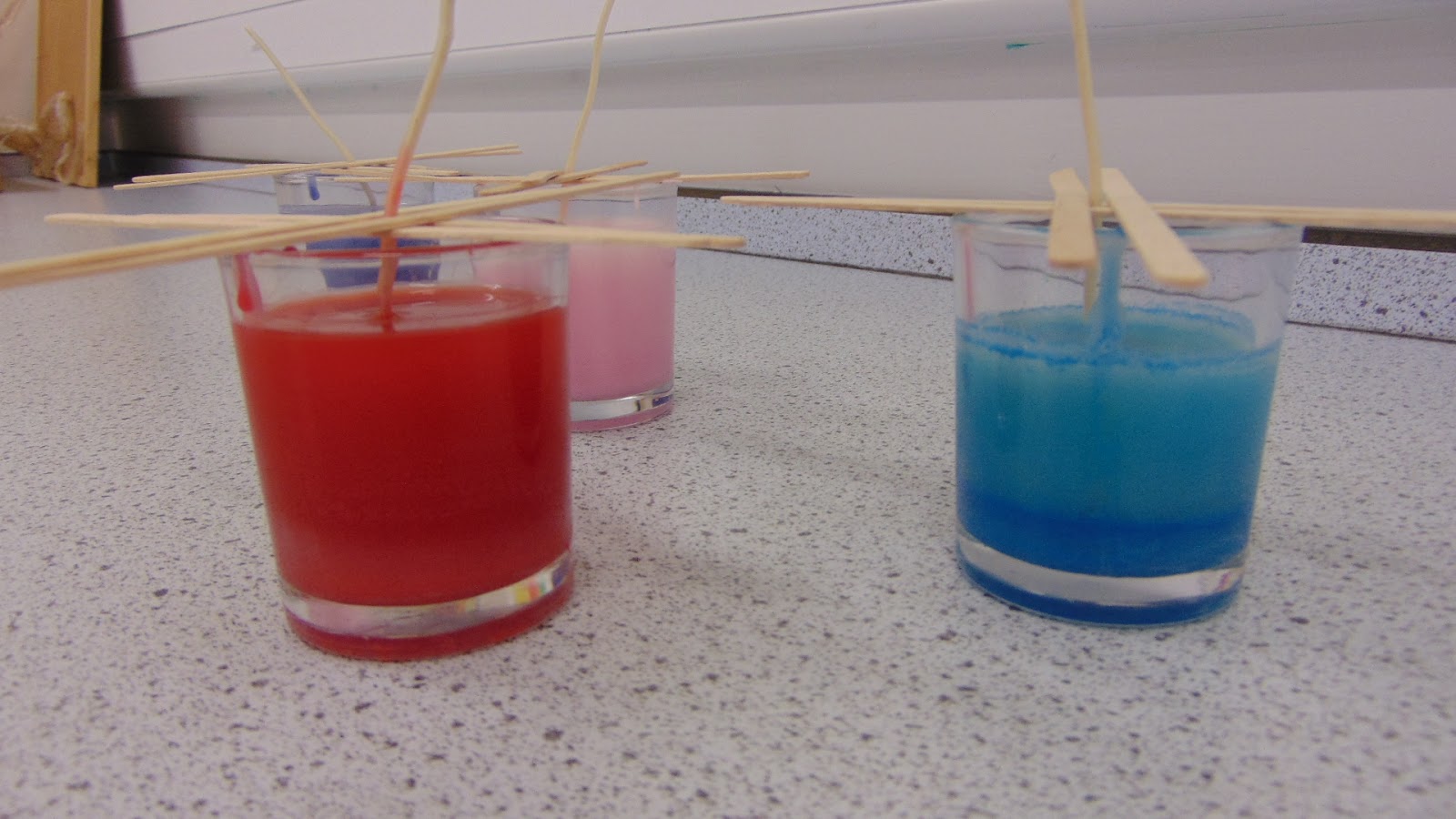
I use paraffin wax pellets as they melt easily. Beeswax is also an option but it will already give you colour.


Add wax crayons for colour. I also use soft drink cans to melt the wax in as this safes me trouble of spending hours to wash the glass beakers.


If you want, you can aslo add essential oils to your melted wax.

 
Once the wax is melted, use the hot glue gun to secure the wick and pour the wax in. If you decide to have layered candles, ensure you have enough time for each layer to cool.


As you can see in the pictures, I use splints to make sure the wick stays straight. 

How can you introduce science to this session?

- wax is a hydrocarbon
- lighted wick melts the wax
- capillary action draws the liquid wax up the wick
- burning candle = complete combusion

More information - click here

I wish you great lessons!

Karolina

Monday, 17 December 2018

Let YouTube help you teach Science #11

What can you teach with this seemingly useless equipment?


Surface tension of water is one of the options. How? Have a look at the video:


This easy to prep experiment is great to merge fun and learning. Click here to read more about the science behind this activity.

I wish you great lessons!

Karolina 

Friday, 14 December 2018

Chemical magic

If you need to run an open evening and showcase your department it´s good to have a selection of experiments and demos that will leave the audience speechless. I have already discussed the classic ammonium dichromate volcano (click here) and today I would like to share some chemical magic. This simple to set up experiment when paired up with a bit of acting can easily surprise your audience as you turn water into wine:


Then wine into water:


and lastly water into milk:


I tested it in beakers but for your "official" demo I suggest following the instructions and use wine glasses and a glass milk bottle.

If not used as a demo, you could use it in your lessons to discuss phenolphthalein as a narrow range indicator. Furthermore, it could be used in precipitation reactions lesson.

I wish you great lessons!

Karolina


Wednesday, 14 November 2018

Book of Achievements for KS3 Science Club


Science Club is for me a place where the students have an opportunity to conduct experiments they wouldn´t normally have a chance to do. It´s an opportunity to further deepen their curiosity and develop lab skills. I created the Book of Achievements to teach my students organisational skills and show them how much they can do. The list of "achievements" to complete is a great starting point to create independent learners who know how to plan.

The reward system is flexible and can easily reflect whatever your school is doing - merits, stickers, postcards home etc.

I wish you great lessons!

Karolina

Dowload the Book of Achievements - click here


Wednesday, 7 November 2018

KS3 Science Club - Scheme of Work


I have been running after school clubs since I started working as a teacher. I really enjoy the freedom a science club can give you to try experiments that you wouldn't normally have time to do in a lesson. One of the restrains that I had to face, however, was the issue of money to buy the resources I needed. This I managed to overcome by applying for grants and getting free resources (I mentioned some of the places here). After testing a wide range of experiments and getting feedback from my students, I put together this KS3 Science Club Scheme of Work, which I hope is going to be useful for your students too.

I wish you great lessons!

Karolina

Tuesday, 30 October 2018

Where to find free resources?


If you are working in a school which provides you with every single resource you ask for, you're in heaven! The reality is, however, that such schools are very rare to find. So, what to do when you want to inspire your students but you are struggling to get resources? Here are some of the places I came across over the years that can support you on your journey.

1. The Crunch Kit (Wellcome Trust)

If you are working in the UK you can get your hands on 2 different kits. These are tailored for  primary and secondary students. Each kit consists of superbly prepared experiments together with all the equipment you need to deliver it.


2. STEM Learning resources

This is a collection of various resources focused around STEM. You can easily find here materials suitable for your students. These can be used both in a classroom setting as well as in an after school club.

3. DIY experiments from STEM Newcastle

This is an amazing collection of experiments perfect for the use in a Science club. Instructions are clearly laid out with numerous pictures and drawings to aid understanding.

4. School Science list

Here you can find a list of 30+ websites which offer free resources.

5. TES resources

Times Educational Supplement is a goldmine for resources. You can find absolutely everything there from worksheets through lesson plans and power points and schemes of work. I started uploading my resources there as well so click here to see what´s available (more to come!).

I wish you great lessons!

Karolina

Monday, 22 October 2018

Let YouTube help you teach Science #3

I really like introducing Science concepts to my students using demos and experiments they can later do at home. This really ensures that the pupils are interested in the subject and maintains their curiosity. Furthermore, if students decide to conduct the experiment at home, it helps to develop their dexterity and lab skills. Here's a simple experiment you can introduce your students to:


Which topics could you use this video with?
- How does soap work?
- How does washing up liquid work?
- Hydrolysis of fats
- Saponification
- Science Club experiment

Key words: hydrophilic, hydrophobic, saponification, soap molecule

I wish you great lessons!

Karolina

Osmosis - biology demo

Over the summer break I managed to complete a few courses on Future Learn .One of them touched on the topic of osmosis. I mentioned last yea...